Posts

Showing posts with the label Experiment

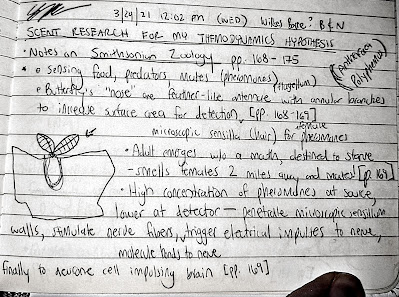
The Passive Smell Hypothesis
Image
 by Steven Gussman THE HYPOTHESIS 1           Why do warm things smell more-so than cold things? The obvious answer is that temperature is just the average kinetic energy of the molecules in a substance: colder things are stiller, and the constituents of hotter things are more-so in motion. This motion should then kick off molecules into the environment where they may be received by noses: smelled. Yet this explanation is purely physical, what if there is another cause, shaped by evolution by natural selection? Perhaps the effect is also by virtue of the fact that by being warm, the scent preferentially travels towards cool noses.           The passive smell hypothesis is that in animals for which smelling is an important sense (for sensing one's inert environment, and for communication via pheromones), the nose is elongated away from the warm body; made of cartilage; moist or runny (especially in colder weathe...

Chapter XVIII: In-Principle And In-Practice | The Philosophy Of Science by Steven Gussman [1st Edition]

          “In theory, theory and practice are the same. In practice, they are not.”           – Attributed to Albert Einstein I           A very important dichotomy that even working scientists frequently mix up is the difference between in-principle and in-practice .   In-principle means something is actually , ideally, ontologically the case.  For example, in-principle , one can deterministically predict which face a flipped coin or rolled die will land on, every single time.  This is because the system is understood: in-principle , if you had perfectly accurate and precise initial condition measurements (such as the object's orientation and the force exerted by the thumb) and applied Newton's kinematic equations, you would get the same (correct) answer every time you performed the calculation.   In-practice , however, means that in the real world where y...