Posts

Is Dark Matter Dark Energy Pressure On Galaxies Or Conserving Energy From Scalar Expansion?

Image
 by Steven Gussman          Two models of dark matter are tested, (perhaps too) simply.  First, is the gravitation associated with "dark matter" actually due to pressure placed on gravitationally stable galaxies by the space expanding around them?  When the space in-between galaxies expands, it stands to reason that the pocket-galaxy in the middle of a sea of expanding space is being squeezed inward.  Unless my physical intuition fails me, it seems that the acceleration associated with the Hubble parameter (in reality, there may be jerk involved) could then be used as an inward velocity on The Milky Way galaxy at the radius of the "dark matter" halo.  If this acceleration were the same as that associated with a galaxy whose mass includes the major contribution of dark matter at that distance, then it would pass the first test.          Rather than using error bars / confidence intervals, I selected a small, mediu...

Is Dark Matter Trapped Dynamic-Density Dark Energy Or Ancient CMB?

 by Steven Gussman         The mechanism behind the present accelerated metric expansion of the universe is not yet well-understood.  Most often, astrophysicists deduce that there must be a "dark" energy of a particular density associated with this expansion.  This is not particularly strange until you realize that the claim is that it is a static scalar field (that is, a field whose density does not depend on its volume; shrink or stretch space and the density of dark energy remains constant).  This rather obviously violates the conservation of energy (of course dark energy must indeed be created and destroyed when spacetime is expanded or contracted).  Astrophysicist  Ethan Siegel is forthright about this: he believes, due to the empirical expansion of the universe, that energy is  not  strictly conserved (and he admirably wants the mainstream to admit that this is their necessary belief as well). [1]    ...

Planck Uncertainties

Image
 by Steven Gusman           My understanding is that the Planck units were discovered when Max Planck simply took the fundamental constants, c, G, and h, and algebraically manipulated them until they returned a unique length, mass, and duration (in other words, he reverse-engineered them through unit analysis). 1  Utilizing the fact that p = mv and E = mc 2 , one can further manipulate the Planck units to include a momentum and an energy.           l p = (hG/c 3 ) 1/2           m p = (hc/G) 1/2           t p = (hG/c 5 ) 1/2           p p = (hc 3 /G) 1/2           E p = (hc 5 /G) 1/2 The small values, length and time, are then naturally assumed by many physicists to be quanta of those variables (or at least of the right order-of-magnitude). That combining the relativistic constants...

The Passive Smell Hypothesis

Image
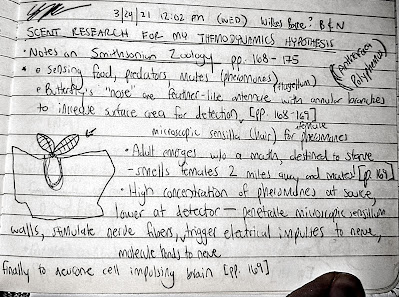
 by Steven Gussman THE HYPOTHESIS 1           Why do warm things smell more-so than cold things? The obvious answer is that temperature is just the average kinetic energy of the molecules in a substance: colder things are stiller, and the constituents of hotter things are more-so in motion. This motion should then kick off molecules into the environment where they may be received by noses: smelled. Yet this explanation is purely physical, what if there is another cause, shaped by evolution by natural selection? Perhaps the effect is also by virtue of the fact that by being warm, the scent preferentially travels towards cool noses.           The passive smell hypothesis is that in animals for which smelling is an important sense (for sensing one's inert environment, and for communication via pheromones), the nose is elongated away from the warm body; made of cartilage; moist or runny (especially in colder weathe...

Towards A Falsifiable Black-Hole Cosmos

Image
 by Steven Gussman THE CONCEPT 1           It is sometimes supposed that what is inside of black holes is another universe (and therefore that our universe may be inside of a black hole within a parent universe). Both our universe and black holes change sizes: the former during the inflationary epoch (sometimes blamed on a scalar “inflaton” field), and less rapidly during the current accelerated expansion epoch (labeled “dark energy” and associated with Albert Einstein's cosmological constant); the latter because it grows when it is impinged upon with the cosmic microwave background (or, less often but more dramatically, when other stellar objects collide with the black hole), 2 and because it shrinks when Hawking radiation dominates, sending energy outward. The Schwarzschild radius of a black hole is defined as: 3 r s = 2Gm / c 2 One can see that the radius and the mass are directly proportional. Yet the CMB impinges on the black hole always...